Best Scratch Remover for Cars vs Rubbing Compound
Paint scratches can be frustrating since they spoil your perfectly polished paint. Once you begin your search for an effective car scratch remover, you will notice that there are two popular products available: the scratch remover and the rubbing compound.
Although they may seem identical, they are not. One of them works effectively on minor paint defects such as light scratches and swirl marks, while the other serves well when dealing with major paint issues like heavy oxidation and clear coat damage.
However, the key to using either product successfully lies in knowing how much cut your paint requires before you rub anything away. Not enough cut means no effect, but too much cut can end up hazing your paint job.

What Is the Best Scratch Remover for Cars?
The most effective scratch remover is one that works for the type of scratch, not necessarily the one that is labeled as the strongest.
Modern automotive paint includes multiple layers. You have your primer, the color layer, and finally the clear coat. The scratch remover deals specifically with the issues on the surface of the clear coat. So you can use it to fix light scratches, swirls, towel scratches, marks left by nails in the vicinity of door handles, and other superficial scuffs.
The scratch remover does its work with fine abrasives, evening out the clear coat surface surrounding the scratches. In effect, you are doing very gentle sanding and polishing at once. There is no magic involved – just evened-out surfaces reflecting light uniformly again.
The rubbing compound is more aggressive. This tool cuts better, and therefore removes much more material from the surface of the body. Such an approach may be required for cases where heavy oxidation, scratches on the clear coat, sanding marks, or poor-quality paint are present. Nevertheless, this increased aggressiveness comes with its disadvantages; the use of rubbing compound instead of scratch remover where it should be used may lead to the appearance of hazing or micro-marring.
There is a very simple rule of thumb here. In case you feel the scratch by pressing your nail on it, a scratch remover can help you to remove it; however, the complete removal of such a scratch is unlikely. Moreover, if the scratch appears white or grey or deep, the damage may affect even the layer of the clear coat. In this case, you should start with Scratch & Swirl Remover.
What You’ll Need for best scratch remover for cars
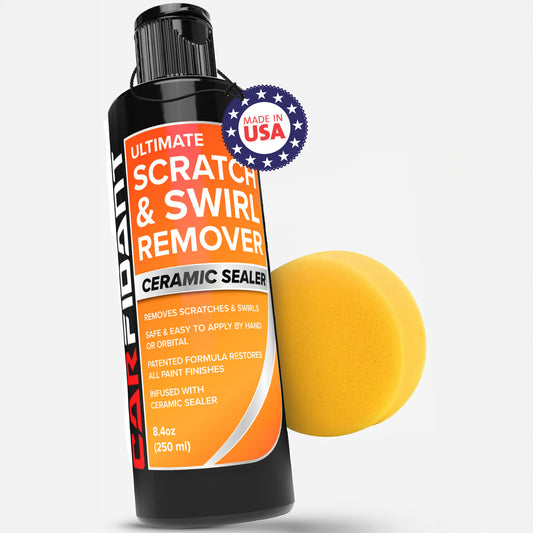
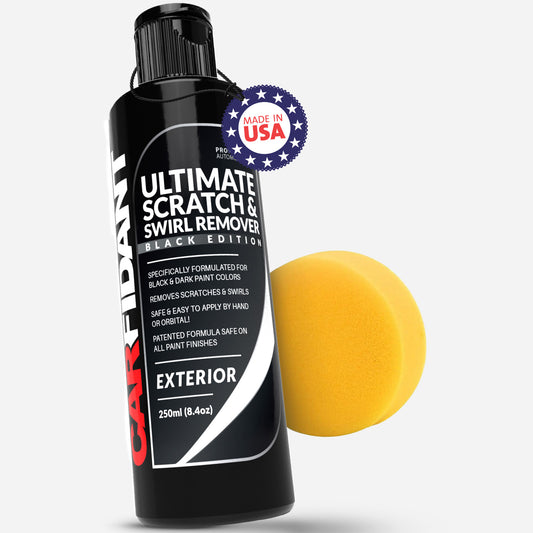
- Scratch And Swirl Remover
- Foam Applicator Pad
- Microfiber Towel
- Painter’s Tape (for test area)
- Adequate lighting/Detailing Inspection Light
- Car Wash Soap And Water
- Clay Bar/Mitt (in case paint surface is not smooth)
- Nitrile Gloves (if you don’t want any product on your hand)
How to Use best scratch remover for cars Step-by-Step

Step 1 – Wash the Area First
Clean the scratched panel prior to applying any remover since the dirt on the paint surface will cause additional scratching. Dry the paint surface with a soft microfiber towel.
Step 2 – Check the Scratch Depth
Gently run a fingernail over the scratch. If it doesn't catch or catches slightly, then there is a possibility that you'll be able to repair the scratch successfully by using Scratch & Swirl Remover. However, if the fingernail falls into the scratch, then it means that it might be possible to improve the situation, yet not completely fix the scratch.
Step 3 – Apply Product to a Small Test Spot
Apply a minimal amount of Scratch & Swirl Remover onto a foam applicator pad. Work on a small area by applying medium or light pressure. Overlap the passes and hold the pad parallel to the paint surface.
Step 4 – Wipe and Inspect
Remove the excess product with a fresh microfiber towel and evaluate the result under different angles. Hint: shine a flashlight on the surface obliquely. This method allows to detect any remaining scratches.
Step 5 – Repeat Only If Needed
Repeat the process one or two times if necessary only. However, it's important not to rub the same spot indefinitely. In case you've already managed to fix all the scratches, stop doing so.
Tips to Prevent Problems

Most scratch removal issues arise due to haste. Correction of paint works best when the surface is free of dust, cool, and dry.
Never apply scratch remover to warm paint surfaces as heat causes drying of the product and may make the process difficult. Always operate in a shaded place or a garage. In addition, never use an abrasive towel, paper towels, worn-out T-shirts, or dirty applicators since they could cause more scratches when removing the old ones.
Start with the most mild approach. Scratch & Swirl Remover is a good choice for initial treatment of small defects since it allows you to be in charge of the process. Rubbing compound should be used only for heavy defects and paints that require tough cutting action. However, finish up with wax, sealant, or ceramic spray in case the compound leaves some haze behind.
Mask the area where you will treat before correcting a large area. This will enable you to compare the corrected paint to the untreated area. In addition, you will not exceed the required time when working on a particular panel.
Finally, always protect the treated paint surface. A cleaned and polished surface has little self-protection power. Use wax, sealant, or ceramic spray when the paint looks perfect.
FAQ About best scratch remover for cars
Is scratch remover the same as rubbing compound?
No. Scratch remover is less aggressive and more effective on minor scratches, swirl marks, and surface scuffs. Rubbing compound is more aggressive and designed for more severe scratches and blemishes.
Can the best scratch remover for cars remove deep scratches?
Yes, to some extent, but it cannot repair a scratch that penetrates the entire clear coat. If the scratch goes all the way down to the primer or base layer, you will need to apply touch-up paint.
Should I use rubbing compound first?
No, try starting with the softer solution. Only if Scratch & Swirl Remover is unable to provide sufficient correction should you consider moving on to the more aggressive solution.
Can I use scratch remover by hand?
Yes, if necessary, you can apply scratch remover by hand using a foam applicator and even pressure. However, in most cases, a power polisher works much faster and more effectively.
Will scratch remover damage clear coat?
Any abrasive solution damages the clear coat to a certain extent. Proper use of scratch remover is generally considered safe. However, the risk increases when applying too much pressure or spending excessive time on polishing.
Conclusion
However, the most effective car scratch removal treatment does not necessarily need to be the most powerful one. For minor damage such as light scratches, swirls, and small scratches, it is better to apply Scratch & Swirl Remover first.
There are cases where rubbing compound should be used, although it tends to be aggressive compared to other treatments.

| # | Anchor | URL | Type |
| 1 | Scratch & Swirl Remover | https://carfidant.com/products/ultimate-scratch-remover | Product |
| 2 | how-to-remove-scratches-from-your-cars-paintwork | https://carfidant.com › blogs › news › how-to-remove-scratches-from-your-cars-paintwork | Internal |
| 3 | remove-scratches-from-car-deep-vs-light | https://carfidant.com › blogs › car-care-tips › remove-scratches-from-car-deep-vs-light | Internal |
| 4 | car-buffing-remove-scratches | https://carfidant.com › blogs › car-care-tips › car-buffing-remove-scratches | Internal |
| 5 | best-car-scratch-remover-that-actually-works-in-2026 | https://carfidant.com › blogs › car-care-tips › best-car-scratch-remover-that-actually-works-in-2026 | Internal |